Showing posts with label Mormonism. Show all posts

Sunday, March 20, 2011

LGBT-related Modern Mormon Murder In My Local Ward

By Mister Curie

I am reeling from this news.

One Mormon in my ward killed another Mormon in my ward by stoning to death for supposed "homosexual advances", trying to follow the biblical injunction that homosexuals should be stoned. While I wasn't close with either, I had seen them both at church. I actually had spoken unknowingly with the murderer between the murder and arrest. Both were converts within the past 2 years or so.

I guess this is one explanation for why the ward has left us alone so much. There were much bigger issues than a couple of apostates leaving the church . . . WOW!


I don't know what to do with this information.  So I am posting a couple of links while I process through this.

EDIT: I have updated my blog with some personal reflections on the murders here.

Story that confirms the Mormon Connection: http://www.delcotimes.com/articles/2011 ... 746326.txt

Video story here: http://abclocal.go.com/wpvi/story?secti ... id=8020716


Sunday, January 23, 2011

My Mormon.org profile, again

By Mister Curie

So I haven't been able to figure out how to link to my facebook account, so I disabled that functionality with my mormon.org profile and have been waiting to see if anything would happen.

I finally got a response on my homosexuality question that "the statement is to (sic) harsh for the audience it would go to. thus it is not cleared."  I am pleased that President Kimball's statements on homosexuality are no longer deemed appropriate, but I am a little disturbed by the qualifier of "for the audience it would go to."  Is this an attempt to placate me so that I don't think they are questioning my answer, or is this an attempt to give good PR to church, giving me a wink that they agree with me but we don't want to come across as harsh to investigators?  If the later, isn't this just the continuation of dishonesty and double-speak that has plagued the church since its beginning?


So I have edited my answer on the question of homosexuality down to: "The Mormon church is firm in the conviction that homosexual behavior is offensive to God and actively works to support legislation against same-sex marriage."

I guess we'll see if that gets accepted.  My answer on the Holy Ghost is still "Pending Review."

Tuesday, January 4, 2011

My Mormon.org profile, reprise

By Mister Curie

As some people have noticed, my Mormon.org profile has been taken down.  I was not given any warning or reason for my profile's removal.  In fact, the profile was initially completely deleted from my account.  I wrote to technical services for an explanation, but they have not responded.

After getting the profile initially approved, I was making minor changes to see what types of things could be done to a Mormon.org profile.  When you complete your profile, it tells you: "Thank you for completing your profile. You can update your profile at anytime. If parts of your profile below show "Pending Review," that means they are being reviewed before appearing on Mormon.org. We will notify you through email as soon as your profile changes are approved." (Although I must note that I never got an email telling me my profile was approved or needed revisions or anything.  I guess that functionality of the cobbage wasn't completed.) I had every intention of posting some follow-up posts about what could be changed once a profile was approved, how the process worked, and how long it took.  First, I deleted one of my more faithful answers, although I still had more than the minimum number of questions answered.  The approved profile and the deleted question remained posted for several days until the profile was finally updated with the question removed.  Because the original profile remained posted, I figured that as long as I kept all the minimum requirements I could make some larger changes.  I tried linking my facebook account to the Mormon.org profile, an optional functionality.  I changed my demographic data so that my "previous religious background" was agnostic/atheist. I also tried tweaking my answer to the question on homosexuality that had never been approved, as I previously noted.  My new answer read:

When I was young, one of our highest leaders, the prophet, then President Spencer W. Kimball, taught about homosexuality: “This perversion is defined as the sexual desire for those of the same sex or sexual relations between individuals of the same sex, whether men or women. It is the sin of the ages.” And later he uses these adjectives to describe homosexuality: repugnant, deviant, unnatural, abominable, evil, ugly, and curable.  Today the church uses less charged language but remains firm in the conviction that homosexual behavior is offensive to God and actively works to support legislation against same-sex marriage.
I also answered a new question:    My answer was:

The Holy Ghost is the third member of the Godhead and His job is to testify of truth. We experience the Holy Ghost as feelings of conviction, sincerity, and a feeling of comfort and warmth (sometimes referred to as a "burning in the bosom.") These feelings direct us in times of uncertainty and difficulty as we are seeking God's will for our life. Such firm emotional manifestations are a way to understand God's will and free us from being tied to the changing ideas and whims of the world.

I suppose I was trying to change too many things at once, but I was impatient.  I suppose that any of those things may have gotten my profile pulled.  Or perhaps so many changes caused warning flags and they looked at my profile a little more carefully.  Or perhaps a TBM friend reported my profile.  I don't have any answers.

Before publishing this post, I checked my account again and my profile has returned to my account with a note saying that I need to revise the link to my facebook account.  As far as I can tell, the link should work.  The link is: http://facebook.com/turgenev13. I would be grateful for someone who is not my facebook friend to check this link to make sure it works.  Or perhaps David Baker would like to give me some advice on how he got his mormon.org profile linked to his facebook account.

My changes to the homosexuality question and the new answer to the Holy Ghost question are still "pending review".

I will keep working to get my profile back up.

In the meantime, I've gotten several requests for the screenshots I saved of my profile.  So here they are, just in case my profile is eternally in outer darkness.

 I apologize in advance for the quality, but I hope it is legible.


Monday, January 3, 2011

Sunstone DC

By Mister Curie

Sunstone recently announced that there will be a regional conference in Washington DC on May 20-21st.  There is also a call for presentations due March 4.  Madame Curie and I are hoping we will be able to attend.  Anyone else thinking of attending?  We'd love to meet up with people.

Thursday, September 2, 2010

My Mormon.org profile . . .

By Mister Curie

When I heard about the makeover going on at Mormon.org, I got an idea to try an experiment.  I wanted to test the boundaries of what could get approved by the church.  Clearly this was a  PR move by the church, so what would happen if someone tried to publish very blunt responses to tricky questions?  My first honest attempts clearly didn't pass PR guidelines, as I gave legitimacy to FLDS claims to be Mormon and critiqued members for failing to obey the Word of Wisdom as given (positive use of mild barley drinks and whole grains and limiting meat consumption), instead of simply meaning no coffee, tea, alcohol, tobacco. So I decided to try answering some of the FAQs with a response that a true believer wouldn't blink at, but that would make investigators squirm a little and think twice about, including incorporating some of the doctrines anti-mormons rant about.
 
As a result, my profile was published and is officially part of the church's new Mormon.org PR campaign.  At the risk of losing the protection provided my anonymity, here is the link to my Mormon.org profile:

http://mormon.org/me/1V3Q-eng/

So, while I'm giving up anonymity, feel free to add me on facebook.

On a positive note, they are still debating over whether to publish my offensive response to what Mormons believe about homosexuality.

What is the Church’s attitude on homosexuality? Why is homosexuality and same-sex marriage important to the Mormon Church?

When I was young, one of our highest leaders, the prophet, then President Spencer W. Kimball, taught about homosexuality: “This perversion is defined as the sexual desire for those of the same sex or sexual relations between individuals of the same sex, whether men or women. It is the sin of the ages.” And later he uses these adjectives to describe homosexuality: repugnant, deviant, unnatural, abominable, evil, ugly, and curable.

I appreciate the irony that if President Spencer W. Kimball made an honest profile, his wouldn't be approved.

But it does frustrate me that this language was deeply ingrained into me as the mind and will of the Lord and that the church's stance contributed to my inability to accept my homosexuality.

Saturday, July 3, 2010

My First MoHo Meet-up

By Mister Curie

After several failed meet-up attempts with various different MoHos, I finally had my first MoHo meet-up when we went to NYC Pride last Sunday and were able to meet Horizon.  I was surprisingly calm about this first meet-up, perhaps Horizon's post about his first meet-up helped reduce my anxiety, helping me realize how normal and ultimately unfounded such anxiety usually is.  Horizon had staked out an amazing location along the parade route, right across from the Stonewall Inn and in the shade.  While New York crowds are typically large, the parade crowd was particularly dense, and I had to send a comical series of texts to find him in the crowd, even though we were already located across from the Stonewall Inn, and eventually discovered we were less than 20 feet from him. We chatted throughout the parade and had a great time.

After the parade we battled the crowds as we attempted to make our way to the Pride festival. Once finding it, Madame Curie insisted we get dinner in an air-conditioned restaurant, which ended up being a great suggestion, as it helped us recover from the heat and got us away from the crowds where we could have a great conversation.  It was nice to share our story with Horizon, hear the outlines of his story, and compare notes.  I was struck with how "normal" my fellow MoHo is.  I realize how naive that sounds and intellectually I had concluded that homosexuals are normal people, but it wasn't until this first meeting that I emotionally connected with the concept that homosexuals, and MoHos in particular, are normal.  It reminded me of the Harvey Milk quote, "so that two, three, four, five hundred will step forward, so the gay doctors will come out, the gay lawyers, the gay judges, gay bankers, gay architects ... I hope that every professional gay will say 'enough', come forward and tell everybody, wear a sign, let the world know. Maybe that will help."  Milk recognized that the stigma and misconceptions about gay people could most effectively be dispelled by knowing someone who is gay, because gays are normal, good people, but there is an emotional aspect to understanding which only comes from personal experience.  I concluded that Horizon is a really good Mormon boy with all the hopes, dreams, fears, aspirations, and challenges associated with that, and he's attracted to men (almost a side note to an amazing and complex fellow human being).

After dinner, we explored the festival and then made our way back to the Metro. Shortly after we said our good-byes and left Horizons behind to make our trip back to Philadelphia, I reflected on our visit, and suddenly unanticipated waves of emotion, largely consisting of sadness and anger, washed over me.  The visit had been so positive, it was hard to understand where such negative emotions were coming from, and I eventually concluded that the feelings were arising from deep within and while the visit was a catalyst for releasing those emotions, they reflected more about what was going on inside myself than about our actual meet-up.  I think many of the feelings were released because of how much of myself I recognized in Horizon.

I have identified the following categories of where I think these feelings are coming from:

(1) Loss of faith - I perceived in Horizon an abundance of faith and an intact Mormon worldview, both of which I have lost.  I think our meeting made me face how much I feel I have lost by losing faith in Mormonism.  Of course, the frustrating thing with my intellectual apostasy is that the church is demonstrably not what I believed it to be in my child-like faith, and I cannot envision a route to go back to that faith.  My loss of faith has parallels to the natural loss we feel in growing up and leaving our childhood behind.  But there is a very real loss there, even if the church was not all I believed it to be.  I think these feelings are ample evidence that I still have a lot to process with my loss of faith and that I am not yet okay with having lost my faith.  I had been exploring my loss of faith when I got distracted by exploring my sexual orientation.  While I think my current belief system is probably relatively stable, I have not yet explored adequately the emotional impact of losing Mormonism and how to integrate that loss of faith with my experiences within Mormonism.

(2) Brokeness/Evilness - I saw in Horizon a reflection of the person I believed myself to be, a good Mormon boy (who is also attracted to men) and suddenly I realized that good Mormon boy and homosexual didn't have to be contradictions.  While I went most of my life unable to accept that I am gay and largely externalized those attractions by attributing them to Satan, I think deep down I internalized the message that if I was "struggling with these temptations" perhaps it was because I was intrinsically broken or evil inside.  And while I usually told myself that I believed I was a wonderful person, deep down (almost beyond conscious thought) I wondered if the continuation of these "temptations" despite faithful church service and belief, was because I was broken and evil.  I remember in Mission Prep, our teacher had challenged us to serve faithfully and then go to the temple at the conclusion of our mission and "return and report" on our mission.  He promised us that if we were faithful missionaries, we would have an incomparable spiritual experience.  I tried hard, despite my introverted nature, to serve the Lord with all my heart (however, I have previously documented some of my challenges on my mission with falling in love with companions and struggling with pornography and masturbation).  The day after returning to America, and before being released as a missionary, I went to the Salt Lake Temple to "return and report."  Nothing happened.  It was one of the most singularly disappointing moments of my life and while I later tried to convince myself that I got my answer of acceptance of my mission while watching "The Testaments" with its HeartSell-induced "spirit", I think I really worried that God didn't accept my mission and that I was somehow evil and broken beyond what my best effort could overcome.  Meeting Horizon exploded a deeply-held, internalized caricature of what it means to be homosexual (namely evil and choosing a lifestyle).  In that moment there was renewed acceptance of myself, but there was also a burst of anger at the church for promoting such a psychologically-debilitating view of myself.  As an acquaintance recently told me, "There is no such thing as people 'struggling with same sex attraction.' Ultimately that's nothing other than hate language expressed from a persecuting world-view. It's simply harmful and life-destroying."   


(3) Family Reactions - Horizon spoke to us of his intention to "come out" to his parents this coming week.  That brought up for me the fears of how my own family might react if I "come out" about my own homosexuality and my disaffection from the church.  If being homosexual is bad in the church, I think being disaffected is even worse.  Again, responses to both are typically filled with "hate language expressed from a persecuting world-view".  It made me sad to think of the intolerance and fear being directed at a good, Mormon boy and how damaging that experience can be to a good, Mormon boy.  It made me mad to think of the damage Mormonism can do to a person who doesn't fit in.  It makes me sad, fearful, and angry to think that my family may react in similar ways to myself.  And because they are fully immersed in that worldview, there is nothing I can do about that.  Horizon, I sure hope your family reacts favorably to your "coming out" this week.

(4) Predicted loss - All of my fears about my family reaction also play into my predicted loss.  I have always been considered the "perfect child" and in many ways have held a privileged place in my family (sorry to Grizz who reads this and my other siblings who don't).  In fact, when I first came out to Grizz, he said, "It's funny, because you were always the perfect child."  I joked that "I'm still the perfect child!" but I think there is a definite fear that my relationship with my family will change for the worse when they learn about my disaffection and homosexuality.  Probably foolishly, much of my life has been spent trying to please others.  Many of the things I have done have been with the intent of obtaining praise and fulfilling expectations that others had for me.  I fear that by being true to myself I will lose a lot of what I have spent a lifetime cultivating.

Despite the confusing emotional response after the fact, I'm very grateful for having had the opportunity to initiate a friendship with Horizon who is such an amazing person, and I'm grateful for the opportunity I've had to sort through these emotions.  I'm already looking forward to my next MoHo meet-up!

Saturday, June 26, 2010

July 2010 Ensign

By Mister Curie

I received my July Ensign in the mail yesterday.  Just in case anyone has forgotten the official stance of the church on homosexuality, there are two explicit references toward homosexuality.  On page 51, Elder Ballard reiterates that "No one is to engage in sexual relationships outside the bounds the Lord has set.  This applies to homosexual behavior of any kind . . ." and on page 11 in the "What We Believe" section it advises that "If you are struggling with sexual temptations, including feelings of same-gender attraction, you can choose to resist those temptations."  Labeling my feelings as "temptations", as if they were some external force and not originating from myself, was one of the things that kept me from accepting that I am gay.

Most issues of the Ensign scrupulously avoid including pictures of cute guys, but this month's issue does not disappoint.  Enjoy!

Wednesday, June 23, 2010

Research Ethics: Aversion Therapy at BYU

By Mister Curie

The conduct of Human Subjects Research is largely directed by common sense principles of respect for fellow human beings.  These principles were first codified in 1946 in response to the medical research atrocities of the Nazi Regime and are known as the Nuremberg Code.  This code first vocalized the need for voluntary consent and that the benefits must outweigh the risks.  In 1964, the World Medical Association gave recommendations for human subjects research known as the Declaration of Helsinki, which added the declaration that research participants must not only be voluntary, but that they must also have informed consent.

These common sense principles were referred to in Quiet Song's comment on yesterday's post, saying: "And just how did said student find his subjects? Were they shanghaied in the then student union, hung by their ankles, or forced to give up their diplomas if they did not participate in Dr. Defacto's research? (voluntary consent) Lied to? (informed consent) Secretly sterilized? (benefits outweigh risks) Given no disclosure that they were research subjects? (informed consent)"

What is the evidence that these principles were adhered to in the performance of aversion therapy research at BYU in the mid-60's and 70's?

(1) Voluntary Consent - BYU students suspected of being homosexual were interviewed and the extent of their homosexual behavior determined.  If the student was allowed to remain a BYU student on probation, the student was required to undergo therapy (not all of this therapy was aversion therapy, but the required therapy sometimes progressed to aversion therapy).  Therapy in general was clearly not voluntary, as it was required to remain a student.  In addition, BYU students suspected of being homosexual were identified through a variety of methods, including confessions of other homosexuals, spies, identifying cars at known gay hang-outs, etc.  I am unable to determine if the aversion therapy was on a voluntary basis in addition to other therapeutic modalities, but given the means used to identify homosexuals and the requirement of therapy to remain a BYU student, as well as the psychological weight of expert opinion from the therapists, I presume that participation was not entirely voluntary.  Furthermore, prophetic pronouncements on the evils of homosexuality and perceived involuntary "outing" to family and friends as a result of expulsion are likely to create an atmosphere where true voluntary consent would be rare.

(2)  Informed Consent - All participants signed a statement of consent to the aversion therapy (at least in the McBride study for his PhD dissertation).  Participants were informed that the therapy was experimental in nature, would produce a "great deal of discomfort" with potential "tissue or organ" damage, and would involve materials that could be construed as "socially or morally offensive" (pornography).  However, is this truly informed consent?  One of the well-documented deficiencies in many consent processes is when participants mistake a research study for a therapeutic intervention.  Given that aversion therapy was recommended in the process of therapy for homosexuality as a prerequisite to continued education at BYU, it is highly likely that students perceived the study as therapy and not research.  How well does the consent document distinguish this study (part of a research PhD dissertation) as a research study and not as a therapy?  While the document does call the therapy "experimental", the title of the consent document refers to the therapy sessions as  "treatment procedures" and the document refers to "therapeutic objectives" and the therapy as a "treatment".  Based on the consent language and the propensity for research participants to mistake research trials as therapeutic trials, it is highly likely that participants felt they were receiving experimental therapy and not involved in a research protocol.  One wonders if the scientists also forgot that they were performing experimental research and not provided therapy.  The consent should have clarified that this is a research study without known clinical benefit and that participation was primarily for research and primary goals were to further scientific knowledge and not for therapeutic improvement with any therapeutic improvement being secondary.

3) Benefits outweigh risks - Here potential benefits are hard to quantify as faithful Latter-day Saints would likely view the potential benefit from the procedure (conversion to heterosexuality) as nearly unquantifiable as adherence to the commandment to marry and have kids would enable the new heterosexual to obtain Godhood and worlds without number, justifying nearly any level of risk.  A more modest assessment of the benefits being a slight decrease in homosexual attraction hardly justifies the physical and psychological damage induced by the therapy.  Care should have been taken to ensure that no lasting physical damage was inflicted, particularly in light of unproven benefit.

In this assessment I do not wish to convey the impression that BYU was alone in the 60's and 70's in failing to adhere to published human subjects research guidelines and common sense principles.  And certainly some of the more extreme experimental treatments of homosexuality, such as chemical castration and experimental brain surgery, were not performed at BYU.  However, for a church that claims exclusive revelation and prophetic insight into God's will, I would have hoped that it would not follow the trends of secular research, particularly when such research ultimately fails to produce the desired results.  The BYU aversion therapy experiments are simply further evidence that the church's policies toward homosexuality are inconsistent over time, are not divorced from prevailing public opinion (at least among conservative religious thought), and fail to engender confidence that current church policies mirror God's will and will not change in the future.  Furthermore, there is a disturbing departure from eternal principles with the introduction of pornography into therapy, suggesting ethical schizophrenia.

Tuesday, June 22, 2010

Feeling Sick

By Mister Curie

While I have heard accounts of aversion therapy used at BYU, and while I believed those accounts, it just doesn't quite give me the same visceral reaction as when I see documentation and evidence.  I just read the best documented evidence I have seen to date of the role of aversion therapy at BYU, here (included are screen shots from the BYU PhD disertation on using aversion therapy on homosexual BYU students).  You can even search the the Harold B. Lee Library online archives and find uncontrovertible evidence that the disertation exists.

While the documentation does not provide the most emotional description of aversion therapy, seeing hard evidence affects me in a way that not even an emotional narrative can.  It makes me feel sick.

Perhaps one area where this reaction comes from is learning that aversion therapy was part of a PhD disertation.  Being a PhD student myself, I have a strong reaction to a fellow PhD student harming human beings by performing aversion therapy. 

Sunday, June 20, 2010

Feeling Annoyed

By Mister Curie

So I just noticed this recent post on the MoHo Directory about a fireside in Idaho Falls:
http://ldslights.org/?p=546.  It is essentially for "instruction and encouragement for Priesthood leaders, for those who experience same-gender attraction, and for friends and family. Presenters will include Priesthood leaders and mental health professionals."  But not only that, "we are also honored to announce that Ty Mansfield, co-author of In Quiet Desperation, will be our feature speaker."

So they are trotting out Ty Mansfield, who will have been married for just over a month, to tell gay Mormons how life will be good if they will just follow church leaders and trust that there is a woman for them.

There was a lot of debate over Ty Mansfield's decision to get married.  Some of that debate led to the creation of a website warning Ty Mansfield and his fiance that they may not be making the best decision.  That led to more debate.  Most people I heard from, thought it was inappropriate to tell two consenting adults how they should live their life and that Ty and Danielle were within their rights to decide to marry, and others should leave them alone.  Even those who recognized that Ty's prominent place in the gay Mormon community made this decision more public than others usually agreed that their decision should be left alone, despite the fact that struggling gay Mormons might see this action as further evidence that they should try to find a woman to marry so they could fulfill the Plan of Happiness (TM).

However, now Ty Mansfield appears to be all too willing to not just let his private decision subtly influence impressionable gay Mormons, he is going on a talking circuit to trumpet his "correct" decision and provide an example to others.  I had assumed Ty, in making his decision to marry Danielle, was going to quietly disappear from the gay Mormon scene.  Rather, it appears he is going to remake his image and make a new debut on the gay Mormon scene with a wife at his side.  What can the engaged recently married Ty Mansfield tell gay Mormons "struggling with SSA" to make them feel better?  What advice can he give?  And how many lives will he ruin as a result of those following his advice?

Saturday, June 19, 2010

Mormon Doctrine: On Homosexuality

By Mister Curie

A recent post by Kurt discussed the entry on Homosexuality in the Topical Guide of the LDS version of the scriptures.  The church has been redefining its views publicly on homosexuality, maintaining that being attracted to the same sex is okay until you physically act on it.  However, if you look up Homosexuality in the Topical Guide, it refers you to the topic of Sexual Immorality.

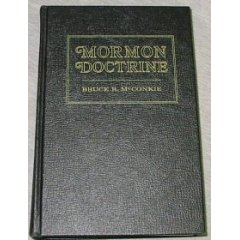
When I was growing up I often turned to Bruce R. McConkie's Mormon Doctrine for guidance.  Happily that book is going out of print and will no longer be carried by Deseret Book (a similar fate would be ideal for Kimball's Miracle of Forgiveness).

If you look up "Homosexuality" in Mormon Doctrine, the only entry states: "Homosexuals. See Sex Immorality".

I remember as a youth struggling with masturbation and turning to Mormon Doctrine to see how bad it really was.  If you look up "Masturbation" in Mormon Doctrine you get: "Masturbation. See Sex Immorality."

The entry for Sex Immorality is long in Mormon Doctrine, so I will not reproduce it in its entirety.  However, some of the gems include:

"Sex immorality is made up of offenses against God of all kinds and degrees.  All are evil and damning in their nature"

"Every degree and type of lewdness, lasciviousness, and licentiousness; of concupiscence, prostitution, and whoredomes; of sodomy, onanism, and homosexuality; of masturbation, incontinence, and perversion; of rape seduction, and infidelity; of adultery, fornication, and uncleanliness - all these things, as well as many others, are condemned by divine edict and are among Lucifer's chief means of leading souls to hell."

[As a side note, homosexuality and masturbation are again placed next to each other.  While I was looking for information on masturbation, I definitely got the message about the church's stance on homosexuality.]

"And now we desire with holy zeal to emphasize the enormity of sexual sins . . . They are destroying the world."

"We hold that sexual sin is second only to the shedding of inocent blood in the category of personal crimes"

I knew myself as a member of the righteous generation, saved to come forth in the latter-days, a bearer of the Holy Priesthood of God, to bring the world his truth.  It was impossible to reconcile that I might be offensive to God, bringing destruction to the world, and nearly as bad as a murderer.  There was NO way that I could be a homosexual, the thought was revolting.

I knew masturbation was wrong, but I clung to the statement that there were "all kinds and degrees" of sex immorality, and while masturbation was wrong, it was of a lesser degree.  I could be forgiven for masturbation.  I spoke to a very kind Bishop and he assured me that I could be forgiven for masturbating.  Masturbation was something you did and you could be forgiven for sinning, but homosexuality was something you chose to be, turning your entire back on God - or so went my thoughts.  You couldn't be forgiven for something you are.

I later learned that your ability to be called on a mission was in jeopardy if you participated in homosexual experimentation.  I was always so grateful I hadn't given into temptations of homosexual experimentation (not that opportunities were abundant, but thoughts were frequent enough).  Those thoughts, however, like desires to masturbate, were from Satan trying to lead me to hell and keep me from serving a mission, there was no way that such sinful desires could come from within myself.  Ironically, homosexual desires were further evidence of my Divine Nature and the important role I had to play in God's plan, why else would Satan be working so hard against me?  And my thoughts toward women were always of the most virtuous nature, of which I was quite proud, just another evidence of how righteous my spirit was.

It all seems a bit ironic now. . .

Monday, May 31, 2010

Filling in the Gaps

By Mister Curie

Madame Curie and I listed to another excellent installment of Mormon Stories Podcast last night and it really filled in a lot of the gaps.  The podcast guest was Daymon Smith, who did his Anthropology PhD at the University of Pennsylvania (where I currently attend school) on the subject of the  LDS church correlation program.  It was an absolutely fascinating podcast that I highly recommend.  Learning real church history, not the stuff they teach at church, largely led to my disaffection.  It became obvious after doing a minimal amount of research that we do not learn a lot of the real church history because it has been sanitized out of the curriculum by the correlation program.  The question I have had since becoming disaffected from Mormonism is wondering how we went from the crazy 19th century church founded by Joseph Smith that was filled with charismatic gifts and alternative lifestyles (polygamy) with a definite anti-American government bend to the organized and decidedly American religion we have today.  In studying church history, it seemed to me that there was a shift in things around the turn of the 20th century, right around the time that Utah was obtaining statehood and polygamy was being banned.  But it was more than just banning polygamy, so that didn't explain everything.  Daymon Smith researched this exact time period of the church and has some fascinating  insights.

I was raised as a "Correlated Mormon" with the false world view that the church correlation program provides.  The church correlation program gives the impression that the LDS church is the receptacle of eternal truths that have always been present throughout history because they come from an Eternal God.  This gives the impression that modern inventions, such as the Temple Endowment, were originally instituted with Adam and Eve and have been repeated in all dispensations of the world, such that a temple endowment was performed in the Jewish tabernacle and temples (such as Solomon's temple), and that Christ gave his apostles the endowment (but evil and designing men removed reference to it from our scriptures), and that even BoM peoples had the temple endowment.  Such correlation reinforces processes that Joseph Smith initiated with his translation of the Bible and the Book of Mormon.  Correlation presents the image that if the Bible had been translated properly and not altered by evil men, it would largely read like the Book of Mormon with its testimonies of Christ, as if Old Testaments prophets (and you could group Lehi, Nephi, and the Brother of Jared into people from the same time period as Old Testament prophets) knew and bore testimony of Christ.  Once you strip away the correlated world view, it becomes obvious that the Book of Mormon is a 19th century religious commentary that doesn't even match our own correlated doctrine.  Abinidi's sermon to King Noah is not an exposition of the Godhead (where the role of the Holy Ghost wasn't cannonized until the early 20th century largely through the efforts of James E. Talmage), but rather a 19th century trinitarian exposition.  The "fullness of the Gospel" with Priesthood ordination, temple endowment, and Eternal marriage are not in the Book of Mormon.  In fact, the current structure of the church that we "Correlated Mormons" know and love has only been in existence since the early 1980's.

My favorite quote from the podcast is: "Through the institutionalization of what is called correlation, you can explain away every error of correlation as an error of faith, but you can credit everything that happens in the church as a result of correlation."  To me, this quote explains how you can find perfectly documented historical information from church history that is simultaneously historically true and "eternally" false. 

I highly recommend the podcast, you can listen to it here:
Daymon Smith

Friday, April 16, 2010

The Meaning of Life

"People say that what we're all seeking is a meaning for life.  I don't think that's what we're really seeking.  I think that  what we're seeking is an experience of being alive, so that our life experiences on the purely physical plane will have resonances within our own innermost being and reality, so that we actually feel the rapture of being alive."

- Joseph Campbell

"I help myself by making a distinction between the idea that 'we make everything up' (which I don't think is accurate) and 'we give meaning to all that we consciously experience' (which I do think is accurate). . . . Each of us has to create our own frame of reference, which ultimately means only I decide if I am acceptable, if my accomplishments are adequate, and if my life matters. . . . [Some have] connected the idea that 'there is no inherent meaning' to the idea that 'it's all pointless'.  Not for me.  The point for me is that I have to get from here to the end of my life and how I do so matters to me. . . . So for me the question is . . . who will define meaning? If I give other people the power to define meaning for me. . . then I guess the point is to live according to the meaning they define.  Or, I can exercise the power within myself to define meaning for myself. . . . But, based on what?  I answer this by considering what I value.  For me that's the point.  What do I value?  I value being a good [partner]. Now I have meaning in my life. . . . I value being smart. Now I have meaning. I value deepening my way of relating with those closest to me. Now I have meaning. . . . and so on."

- Jake Eagle

Having lost faith in Mormonism, I have been questioning what is the meaning of life if it wasn't The Plan?  If there is no God, as I increasingly believe, is there a meaning to life?  These quotes have given me a lot to ponder.  I think that as we recognize those things that we value and then live our life in harmony with those values, we will find that rapture of being alive and joy in our existence.  And I think that just might be enough.

Saturday, April 3, 2010

Seeking a Revelation for the Church

By Mister Curie

One of the common themes I see among faithful MoHo blogs is the hope that someday the LDS church will receive a revelation on the holiness (or at least acceptance) of homosexual marriage.  Often, many explanations as to why the church has not yet received such a revelation are put forth: (1) the church isn't ready yet for such a revelation, (2) the Brethren just haven't asked, (3) etc., etc., etc.  Nearly all faithful MoHos are convinced that homosexuality is part of their eternal nature and that God doesn't not hate them, although there are a few that hold onto the hope that "natural affections" toward women will be restored to them in the resurrection.  Almost inevitably they refer to the revelation granting Blacks the rights of the Priesthood, received under President Spencer W. Kimball.

I listened to a fascinating podcast the other day that delved into how that revelation was actually received.  The podcast is an interview with Edward Kimball, the son of President Spencer W. Kimball.  It is the most straightforward and honest discussion of the receiving of the revelation extending priesthood rights to Blacks that I have ever seen given from a faithful LDS perspective.  I thought that the MoHo community would be interested in hearing the details of how this revelation was received so that they can gauge what must happen in the future before the church will receive a revelation extending fellowship and acceptance to those in a gay marriage.  I think it is safe to say that we will not hear about the reception of such a revelation during General Conference today and tomorrow.

The interview can be found at the Mormon Stories Podcast website: http://mormonstories.org/?p=940.

Wednesday, January 20, 2010

Mixed Orientation Marriage - Squared

By Madame Curie

Sometimes, my husband will understands me better than I understand myself.

Last night, Mister Curie and I had a long conversation about our marriage and the role that sexual orientation plays in it. I had been expressing the concern that, with the fluctuations in the Kinsey scale that naturally occur over time, there would come a time when the idea of kissing me would be repulsive to him. This seems to be a not-uncommon occurrence in many mixed-orientation marriages (MOMs). He explained that he had never been repulsed by me physically, although at times (particularly at the early stages of our marriage) he has been frequently less interested in love-making than I. He then flipped the question to me, asking what I expected the outcome would be if my Kinsey scale shifted rightward again. I started answering the question.

And then... it hit me.

I finally grasped what the "unknown fear" in my future was. I conceptualized what I was worried he would feel towards me.

Before I joined the LDS Church, I was exclusively attracted to women. And I was grossed out when I was physically/sensually involved with any guy. I had forgotten (blocked?) that from my memory. I had forgotten how repulsed and nauseous I often felt while making out with my ex-boyfriends. I had forgotten how those experiences weren't something I had looked forward to with men. They were things that I endured because it was expected, but I never liked it.

I had forgotten how worried I was in the early days of our relationship that I wouldn't want to kiss Mr. C (sorry, honey!). I remember that now. I specifically remember that I was consciously worried about his trying to kiss me when we went on our first road trip together to the Hill Cumorah Pageant, because I didn't think I could without being grossed out again.

Amazingly to me, I actually really liked kissing him - I was surprised by that.

I was also worried on our honeymoon whether I would suddenly stop desiring him. In the past, anticipating the sexual activity was always so much more powerful than actual kissing or touching with men - making out with my boyfriends was always either boring or nauseating. And when the real stuff started, I would always, always, always be repulsed.

Mr. C got an email last night from a fellow MoHo who has been following our blog, and in his response to him, Mr. C wrote:

Navigating our MOM is sure to be an interesting experience, although as I'm still coming out to myself I haven't had to think too much about it yet. Our MOM, while similar to other MOMs in many ways, may also be unique because my wife is lesbian. She describes her sexuality as being incidentally sexual, but from her stories she is essentially only attracted to females (had a girlfriend in high school) and has been repulsed by most men she has dated. I am her exception. She was a convert to the church in college and church dogma convinced her to date only men and she convinced herself that she was becoming more heterosexual. She did not tell me that she was attracted to women until after we had been married for some time...

She claims that she highly suspected I was gay while we were dating, but that it was confirmed to her within the first year of our marriage... She thought it was awesome because she had always wanted to be married to a gay man. Now she is facing the fear that when you marry a gay man, you also face the possibility of only being a "place holder" until the right man comes along. I am gay, but I am attracted to my wife (she is quite possibly my exception as well, or it may be that when I become emotionally close to a person, my feelings of attraction follow). I was never repulsed by
women, I just wasn't interested in them very much.
Have you ever had those moments where you are trying desperately to understand something about yourself, and then someone else explains you to you? This email did that for me.

I hope that he doesn't suddenly become repulsed by me. I hope I am truly his exception.

Friday, January 1, 2010

Coming Out

By Mister Curie

“Coming Out” is typically thought of as the process of revealing one’s non-heterosexual sexual orientation. The DAMU has co-opted the phrase “Coming Out” from the LGBT community to refer to revealing one’s disaffection with the church. Both terms suggest a period of time of hiding in the closet behind culturally accepted norms (such as a heterosexual orientation or believing the church is “True”) when one no longer believes that “norm” applies to oneself, but then seeking the freedom and self-affirmation by revealing one’s sexual orientation or true beliefs. For me, the two definitions of “coming out” are closely tied to each other.

I was a typical TBM (30 year old returned missionary, married in the temple for nearly 6 years with a 3 year old son). I was raised with the conservative outlook espoused by much of the intermountain west, with all of its biases and narrow-minded (I dare say even homophobic) views. Moving to the East coast for school challenged many of my conservative views and I like to think that I became much more progressive and open-minded. However, I believed the church was “True” and led by a modern Prophet of God. Prop 8 came and went without me worrying too much about it. DW and I followed a blog of a person who really struggled with the church’s stance on Prop 8, which led us to have a discussion between ourselves. While I no longer necessarily believed it was appropriate for the church to be politically active on the issue, had I been in CA, I would have voted with the Church on the issue because a Prophet of God told me to.

Then, one day, DW told me that she no longer believed in the Restoration as taught by the church (those who have followed this blog for a while are familiar with her journey). It was very difficult and heart-wrenching to have her "deny the faith", so to speak. I was distraught for a couple of weeks. However, I love my wife very much and I very much value her judgment and insight. I decided that I should do some research into the history of the church, as she had done. My belief system and testimony quickly came crashing down. From that wreckage, I sought to understand who I really am and what I believe. That is the journey I am still on. Without the church-imposed beliefs, I soon recognized a pattern in my life suggesting that I am not strictly heterosexual, but my belief system had kept me from recognizing that pattern for what it was. However, my sexuality didn’t match the stereotypes or labels I had been raised with. I didn’t identify with the LGBT counterculture that I believed defined homosexuality. I sought out the stories of others in an attempt to understand my own. I read some MoHo blogs, corresponded with a DAMU-associated gay, heterosexually married Mormon, called an Elder from my mission who was now “out” and homosexually married, and of course talked with my wife. I soon recognized that people did not fit the stereotypes I had narrowly constructed behind LGBT labels and in many ways I am still unsure of how to label myself. I don’t necessarily feel that I am defined by homosexuality, heterosexuality, or bisexuality. It is just my-sexuality. I want to explore my-sexuality and who I am in a safe and constructive manner. Participating in this blog is one attempt at that.

Hearing stories from others, it seemed that many people struggled with reconciling their sexual orientation with the teachings of the LDS church. I recognized a recurring theme that a MoHo’s sexual orientation often led to their disaffection. So why was it that I was barely aware of my non-heterosexual orientation until after my disaffection? I am questioning now, but I think that I am bisexual. Bisexuality has allowed me to focus on my heterosexual feelings within my LDS belief system and ignore my homosexual feelings. I, unlike many MoHos, was not made painfully aware of my homosexual feelings because I had heterosexual feelings I could explore. I had several fulfilling relationships with girlfriends and of course have a wonderful, fulfilling marriage to DW. I never felt untrue to myself or my sexual orientation in pursuing those relationships. Any homosexual feelings that I chose not to pursue were easily ignored due to my LDS church belief system, as well as the cultural mindset I was raised with. I think being in the church is probably easier for the bisexual than for the homosexual.

This post makes me anonymously “Out” to the world. However, I am not fully “Out” in either sense of the word, LGBT or DAMU. A disaffected sibling and a few other close friends are aware of my disaffection with the church, most are followers of DW’s blog, so I guess I’m “Out” in the LGBT sense of the word to you now. To the rest of the world and my family, however, I still attend church weekly and faithfully fill my calling and appear heterosexual. I am beginning to realize that coming out is not a single event, but a process, repeated over and over again in a variety of circumstances and to a variety of people. For me, it is also a process that must be repeated to the same people about different aspects of coming out, LGBT and LDS. Somewhere in the process, however, I guess I need to understand where I stand and come out to myself. My upcoming series of blog posts will be an attempt to do that, come out to myself. I look forward to hearing the comments and experiences of others as I seek to understand my-sexuality and my-spirituality better.

Thursday, November 5, 2009

The Power of Compassion

By Madame Curie

In the wake of my recent disaffection, I have been much more vocal about my support of same-sex marriage. This cause caused a lot of contention, particularly on places such as Facebook where my apostacy is not so widely known. Tonight, I got to thinking about where my change on this issue occurred. It wasn't so long ago that I seriously started questioning what my response would be if Prop 8 were in Philadelphia, rather than in California. I recall in those days (it seems like ages ago, really) wondering whether it is better to vote your conscience or to vote in accordance with the Prophet. I think I had decided that it was best to abstain from voting, rather than to cause offense either way. Obviously my feelings have undergone a radical transformation. So, what effected the change?

When I was in high school, my best friend Mary* and I fell in love. We meant everything to one another, I believe. We attended prom together, and neither of us dated anyone else while in high school. Our relationship continued through our first few years of college, although we attended different universities. We would travel to visit one another, enormous distances. As our friends married their high-school sweethearts, I remember in my mind thinking of how wonderful it would be to set up a home with my Mary. We would talk about growing old together, no matter where else our life's paths took us, grey and wrinkly on rockers in a cottage by a stream. At times, the situation was somewhat confusing, since I felt that there was nothing at all wrong with our relationship, but she would occasionally feel guilty about it.

When I joined the Mormon church my senior year of college, in my baptismal interview the Elders asked me if I had ever been in a homosexual relationship (this is a standard question in the baptismal interview, I believe). I was a little surprised by this question, as I wasn't expecting it. I answered "no," since I wasn't currently in a relationship with Mary (I had been dating a guy for the past year). However, that question and its implications haunted me for a long time thereafter.

This was honestly the first time in my life that I had ever considered my relationship with Mary to be "bad" in any way. It seemed like such a strange thing, that something so special as the tender love that we had for one another could be wrong. The phrase "harrowed up" goes a long way to describing my feelings for the next several years whenever I would think about myself and how evil and depraved I must have been. Nevermind that when we were dating (although we never called it that), I knew God smiled on us and had sent her to me. I also tried hard to never, ever think back to my relationship with Mary, casting it aside as a confusing and "evil" time in my life.

When Prop 8 hit the scene at the beginning of 2008, and the Church started taking such a strong stand in it, many of the memories with my sweet friend Mary came back to me. It seemed unfair that the Church would try to forbid other homosexuals from marrying, although I frequently told myself that God (through the Prophet) must know better than I. However, as I started seeing myself within the LGTB community, I began to deeply understand where they were coming from, what they wanted, and why it was not only acceptable, but necessary and just. I understood their plight, because it was my plight. Understanding brought compassion, love, and eventually, acceptance - both of the right for gays to marry, and of myself for my relationship with Mary.

Compassion is a powerful thing. It changes a man from mere mortal to something better than himself. Thank God for that.

*Name has been changed

Wednesday, October 14, 2009

Deconstructing Elder Oaks' Prop 8 Devotional

By Madame Curie

In another in a long line of... interesting... publicity moves, the LDS church today decided to highlight in its newsroom a talk given by Elder Oaks yesterday (Oct. 13, 2009) to BYU-I. (Click on the link for the full talk). Unlike with Elder Hafen's infamous talk, this time the talk is featured front and center as the "Top Story".

So, despite the fact that I have three papers due to be edited by 5 am tomorrow morning, I am going to address yet another frustrating talk on politics from the LDS Church. In doing so, let me make it abundantly clear that I am not a constitutional expert or a lawyer. Rather, I am merely looking at this talk as an interesting, intelligent, analytical student of Mormonism. And since the talk was given as a general devotional to BYU-I students, I don't think a law degree should be necessary in dissecting what was said.

Sections I-III: The Consitution is Ordained of God
In the beginning of his talk, Elder Oaks discusses the importance of religious freedoms within the United States, and their role in allowing the Restoration to come to pass. I likewise believe that religious rights are important, as are any individual's rights to express her opinions - dumb or otherwise - untrammelled. This applies to all. I only have a frew nitpicking things to say about this section of his talk.

At the very beginning of his talk, Elder Oaks says:
I am conscious that I am also speaking to many in other places. In this time of the Internet, what we say in one place is instantly put before a wider audience, including many to whom we do not intend to speak. That complicates my task, so I ask your understanding as I speak to a very diverse audience.
Now, given that this talk was knowingly placed as the "Top Story" in the LDS Newsroom, this statement can be taken one of two ways. The first possibility is that he is saying, "Other people who were not my intended audience are going to read this talk, and take it out of context". The problem with that conclusion is that he says that his task is "complicated" by this fact and that he is speaking to a "diverse audience". This seems to indicate that the talk with written with the intent that it would be found on the LDS Newsroom within 24 hours. As such, the second possibility is that, knowing the press this talk would receive, Elder Oaks purposefully chose to make the devotional a political platform. I believe that this was most likely the case.

Elder Oaks continues, choosing to cite an "old military maxim that when there is a battle underway, persons who desire to join the fray should 'march to the sound of the guns,'" inevitably bringing up the thought of the "war on the family" rhetoric. Although it is not immediately clear that this is going to be a talk about same-sex marriage, since he launches into several minutes of discussing the Constitution, this immediate and early reference to war mentality does prep the hearer that the talk will be about Prop. 8.

In discussing the importance of our democracy and freedom from dictatorship, Elder Oaks says:
With freedom we can be accountable for our own actions and cannot blame our conditions on our bondage to another. This is the condition the Lord praised in the Book of Mormon, where the people — not a king — established the laws and were governed by them (see Mosiah 29:23–26). This popular sovereignty necessarily implies popular responsibility. Instead of blaming their troubles on a king or tyrant, all citizens are responsible to share the burdens of governing, “that every man might bear his part” (Mosiah 29:34).
One thing that I always find interesting about the Church's current disparaging remarks on the evils of kings and monarchs, using Book of Mormon citations as scriptural justification, is that the same BoM passages were used by Joseph Smith in the early days of the Mormon church, albeit with a perpendicular purpose. What Joseph Smith intended to form in Nauvoo and throughout the United States was a theocracy. He used King Benjamin from the Book of Mormon as an example of how the Lord actually would prefer that individuals be ruled by a righteous monarch (aka a Prophet). Indeed, records indicate that Joseph Smith had himself annointed King over his theocracy. Very ironic proceedings from a church that now clings to the idea of a democracy as God's ordained governmental institution.

The other difficulty with Elder Oaks' statement is his reference that because of democracy, each man and woman is judged according to his or her own decisions, and not those forced upon them. In other words, democracy allows personal responsibility. The difficulty with this statement is that the LDS Church is very far from a democracy! How is it personally responsible to vote a certain way because the Prophet told you to? Compound this fact with statements from LDS authorities indicating that "when the Prophet has spoken, the debate is over," suggesting that the Prophet can speak on any issues, including politics, and should be obeyed, and that you should follow the prophet even if what he tells you to do is wrong. These statements are at direct opposition with what Elder Oaks describes as the environment necessary for "personal responsibility".

Section IV: What is Religious Freedom?
In this section, Elder Oaks explains what religious freedom within the United States means and doesn't mean. He stresses that it is important that a government ensure that religions do not infringe on others' human rights, as defined in the constitution, such as property rights and the right to life. (Interesting note: What implication does this have on things such as the United Order, where the church basically owned everyone's property and goods?) This argument is carefully constructed so that Elder Oaks can argue that some human rights are acceptable, while others should not be considered rights in the first place.
As would be expected, most of the battles over the extent of religious freedom have involved government efforts to impose upon the practices of small groups like Mormons. Not surprisingly, government officials sometimes seem more tolerant toward the religious practices of large groups of voters.
In making this argument, I am reminded of the government's responses to polygamy. Perhaps this is not what was intended, but whenever a Mormon hears "persecution" and "Mormons" together, it is only natural to think of polygamy. If that is the case, then somehow Elder Oaks must make the cognitive leap that the definition of marriage is not something that the constitution can define, unless the Church agrees with it.

Furthermore, in his last sentence of that statement, he states something that is fundementally true: Government is more tolerant towards larger religious practices, because we are a democracy. Thats how a democracy works - the majority wins. In the case of polygamy, the church was on the "wrong side," and so Mormons cry persecution. In the case of same-sex marriage, the gays and lesbians are unfortunately on the "wrong side" of public opinion - therefore, since Mormons are of the majority, they really have no right to claim "persecution!".
Religious belief is obviously protected against government action. The practice of that belief must have some limits, as I suggested earlier. But unless the guarantee of free exercise of religion gives a religious actor greater protection against government prohibitions than are already guaranteed to all actors by other provisions of the constitution (like freedom of speech), what is the special value of religious freedom? Surely the First Amendment guarantee of free exercise of religion was intended to grant more freedom to religious action than to other kinds of action. Treating actions based on religious belief the same as actions based on other systems of belief should not be enough to satisfy the special place of religion in the United States Constitution.
I am not quite sure what he is trying to say here - religious individuals should have more say in government than the average Joe? How does that work? Or religious individuals should be more protected than the average individual? This seems like shaky legal ground, to me the non-legal oberserver. It seems like Elder Oaks is indicating that Mormons should be extra priviledged politically, simply because they belong to a minority religion. That doesn't seem right to me.

Section V: Religious Freedom is Under Attack

Continuing with his indication that religions and religious persons should be held accounted special treatment from government, Elder Oaks goes into an attack on atheism. He first indicates that, as non-believers, atheists are therefore NOT covered by special privledges held in reserve for the believers:
Atheism has always been hostile to religion, such as in its arguments that freedom of or for religion should include freedom from religion.
In other words, Oaks seems to indicate that atheists should not be permitted in their practice or prosyletization of their non-belief, at least not on a governmental level, because the US Constitution does not validate their non-belief as it does another's belief. In other words, atheists should not have the special "protections" that religious individuals do. I am not sure, again, what Oaks is getting at here. Does he mean that belittling a rationalist's argument is ok, because they are not believers and therefore not covered by the Constitution, but that belittling a believer's argument is NOT ok? What special "protections" is he referring to, anyway?
As noted by John A. Howard of the Howard Center for Family, Religion, and Society, these voices “have developed great skills in demonizing those who disagree with them, turning their opponents into objects of fear, hatred and scorn.”
Such forces — atheists and others — would intimidate persons with religious-based points of view from influencing or making the laws of their state or nation. Noted author and legal commentator Hugh Hewitt described the current circumstance this way:
“There is a growing anti-religious bigotry in the United States. . . .
“For three decades people of faith have watched a systematic and very effective effort waged in the courts and the media to drive them from the public square and to delegitimize their participation in politics as somehow threatening.”
It seems interesting that Elder Oaks would call out atheists for delegitimizing Mormon arguments in the public square, when talks such as this one clearly are meant to have the same effect on atheist's arguments. How else can one explain his statement that "freedom of religion is not freedom from religion"? Furthermore, the obvious analogy within the Mormon faith is striking. It seems to me that talks like this one and Elder Holland's in General Conference seek to "demonize those who disagree with them, turning [opponents of the Mormon Church] into objects of fear, hatred, and scorn." In particular, the words "pathetic," "crawling," and "silly" from Elder Holland's talk come to mind. Kettle, meet pot.

Next, Elder Oaks specifically brings up the question of Prop. 8, and argues that:
At no time did anyone question or jeopardize the civil right of Proposition 8 opponents to vote or speak their views.
I am not sure what Elder Oaks considers necessary to "jeopardize" someones civil right to speak against Prop. 8, but I would think that threats of eternal salvation, ostracization by your family, friends, and religion, and strong urging by your bishop to give money (when he knows full well your financial situation) might make someone fell that their rights to freedom of speech within the church were certainly "jeopardized". However, since the church is not a democracy, feedom of speech can be restricted there. However, that doesn't mean we should cry foul the second someone calls us out on it.
Religious freedom needs defending against the claims of newly asserted human rights. The so-called “Yogyakarta Principles,” published by an international human rights group, call for governments to assure that all persons have the right to practice their religious beliefs regardless of sexual orientation or identity. This apparently proposes that governments require church practices and their doctrines to ignore gender differences. Any such effort to have governments invade religion to override religious doctrines or practices should be resisted by all believers.
I wasn't sure what he was referring to here, so I read all of the Yogyakarta Principles. These principles are a set of non-binding considerations to protect the human rights of LGBTQ individuals. They include the right to life, privacy, education, etc. The only principle pertaining to religion was the following:
PRINCIPLE 21. The Right to Freedom of Thought, Conscience and Religion
Everyone has the right to freedom of thought, conscience and religion, regardless of sexual orientation or gender identity. These rights may not be invoked by the State to justify laws, policies or practices which deny equal protection of the law, or discriminate on the basis of sexual orientation or gender identity.

States shall:
a) Take all necessary legislative, administrative and other measures to ensure the right of persons, regardless of sexual orientation or gender identity, to hold and practice religious and non-religious beliefs, alone or in association with others, to be free from interference with their beliefs and to be free from coercion or the imposition of beliefs;
b) Ensure that the expression, practice and promotion of different opinions, convictions and beliefs with regard to issues of sexual orientation or gender identity is not undertaken in a manner incompatible with human rights.
Considering this principle, I think Elder Oaks was trying to indicate that the above statement could potentially force the Church to perform same-sex marriages in the temple. But such an argument is as ridiculous as indicating that the government is able to force the Muslim faith to do away with burqas. This simply does not say that the government can impose on a religion, PARTICULARLY in a country where freedom of religion is respected by the constitution.

In a country where all-white country clubs still exist, I expect that religions will still be allowed to continue being homophobic and sexist.

Section V: What Should LDS Members Do to Protect Freedom of Religion?

In this final section, Elder Oaks gives words of advice for LDS Members as they fight the war for religious freedom against those evil gays and lesbians (snark mine):
First, we must speak with love, always showing patience, understanding and compassion toward our adversaries. We are under command to love our neighbor, to forgive all men, to do good to them who despitefully use us and to conduct our teaching in mildness and meekness. Even as we seek to speak with love, we must not be surprised when our positions are ridiculed and we are persecuted and reviled. As the Savior said, “so persecuted they the prophets which were before you”. And modern revelation commands us not to revile against revilers.
This quote is great, but seemingly at odds with his GC talk given only one week ago, where he indicated that:
God’s anger and His wrath are not a contradiction of His love but an evidence of His love. Every parent knows that you can love a child totally and completely while still being creatively angry and disappointed at that child’s self-defeating behavior.
Interesting parallels are make here between wrath, anger, and love. I am not sure that I understand how one can be patient, understanding, compassionate, mild, and meek, and not reviling, while simultaneously being justified in righteous wrath and anger.
While our church rarely speaks on public issues, it does so by exception on what the First Presidency defines as significant moral issues, which could surely include laws affecting the fundamental legal/cultural/moral environment of our communities and nations.
Our church "rarely speaks on public issues"??? What the hell Mormon church is he a member of? Surely not the one that advicated and then excommunicated people for practicing polygamy, urged church members to join the John Birch society, spoke out vehemantly against communism and socialism, daily decries the evils of feminism, intellectualism, and gay rights, and put every ounce of its weight behind getting the ERA to fail? What kind of church starts off as a theocratic institution that defines a new order of marriage and communal living, but then 100 years later works the system to block others from marrying?

This is tantamount to the church's explanation that we were "never a racist church" when our own prophets (Brigham Young) declared that any interracial couple deserved "death on the spot". You cannot change history simply by insisting that things occurred differently than they did. In a marriage relationship, this would be considered a form of emotional abuse. But at least a marriage relationship is a democracy - in a Mormon Church/Mormon member relationship, "when the prophet has spoken, the debate is over," and there is no form of redress.
Along with many others, we were disappointed with what we experienced in the aftermath of California’s adoption of Proposition 8, including vandalism of church facilities and harassment of church members by firings and boycotts of member businesses and by retaliation against donors...

These incidents were expressions of outrage against those who disagreed with the gay-rights position and had prevailed in a public contest. As such, these incidents of “violence and intimidation” are not so much anti-religious as anti-democratic. In their effect they are like the well-known and widely condemned voter-intimidation of blacks in the South that produced corrective federal civil-rights legislation.
Yes, illegal things done by some individuals to some individual members of the church were wrong, and legal redress should be attempted. However, the actions of individuals by individuals should be dealt with on an individual basis, rather than held up as a banner from heaven indicating that we are justified. Newsflash: The "victimization" card didn't work so well for Hillary Clinton in the last election. People can see right through it, and they hate it. If you are going to talk the talk, be willing to walk the walk. All is NOT fair in politics. That is simply how it is, and claiming special status as a "believer," indicating that special privledges are yours for belief in God is wrong.

Yes, people were fired and businesses were boycotted. That is how things are done in diplomacy; we had an embargo against Cuba for who knows how many years. The UN frequently enacts economic sanctions on countries that they disagree with. When reason fail, when argumentation turns into "Well, my God says you are wrong," people must take action. The church knows this; they use their power to protect their image as well. "Protecting the good name of the church" is grounds for excommunication. Individuals have been fired from BYU for being openly gay or even for supporting gay or feminist movements. Reputations have been destroyed within the church when books are published that the church doesn't like. I may be ex-ed simply for writing this post. To someone who isn't Mormon, these may seem like small things. But when ones entire sense of self, world-view, cultual, family, friends and community are wrapped up in it - and sometimes their jobs as well - it is a BIG DEAL. So, as I said - if you can't handle the heat, get out of the kitchen. There can be no double standard here.

Furthermore, gays, lesbians, transexuals, and bisexuals have endured much more than just being fired from jobs. They have been discriminated against, killed in horrible fashions, subject to all sorts of intimidation and violence. There is simply no comparison with the push back experienced by LDS church members after Prop 8 to civil rights violations that homosexuals have endured for years.

I have not even touched the issue of civil rights in the South and how pathetic of a comparison it is to the backlash after Prop 8. Its just too ludicrous to compare. As stated in a rebuttal of the talk by the Salt Lake Tribune:
"Were four little Mormon girls blown up in the church at Sunday school? Were there burning crosses planted on local bishops' lawns? Were people lynched and their genitals stuffed in their mouths?" asked University of Utah historian Colleen McDannell. "By comparing these two things, it diminishes the real violence that African-Americans experienced in the '60s, when they were struggling for equal rights. There is no equivalence between the two."
That about sums up my feelings on that topic as well.

Finally, Elder Oaks makes some extensions that can only be understood in light of the fact that Mitt Romney was rejected as Republican nominee for president in 2008, and it clearly planning on a second run:
Fragile freedoms are best preserved when not employed beyond their intended purpose. If a candidate is seen to be rejected at the ballot box primarily because of religious belief or affiliation, the precious free exercise of religion is weakened at its foundation, especially when this reason for rejection has been advocated by other religionists. Such advocacy suggests that if religionists prevail in electing their preferred candidate this will lead to the use of government power in support of their religious beliefs and practices. The religion of a candidate should not be an issue in a political campaign.
Yes, and this clearly did not make a difference in Utah and Idaho, who voted nearly 100% for Mitt Romney in the Republican primaries. Furthermore, I received far more "Obama is a Muslim!" propaganda from my Mormon friends than from any other voting bloc.

I am left baffled as to why Elder Oaks would choose to give a lawyer-speech, chock full of difficult constitutional analyses and references, as a Tuesday devotional talk at BYU-Idaho. Surely most of the students left with their heads spinning. This talk can only be perceived as a marker of the church's stance on Prop 8, and its unwillingness to let the argument pass out of the public eye. I disagree with the victimization card, and with the blatent attempts to align the Mormon church with the evangelical Protestants. The Protestants are not going to accept Mormon doctrine as Christian, no matter how much we align ourselves with them or donate money to their causes. What the Catholic Church has been unable to do since the Reformation, Mormons are unlikely to succeed at in the Internet era.

UPDATE: Keith Olbermann had Elder Oaks on his Countdown tonight as the 5th "Worst Person in the World":


Saturday, September 26, 2009

The Salt Lake Tribune Reports on Hafen's Talk

By Madame Curie

The Salt Lake Tribune on Friday reported on the furor surrounding Elder Hafen's talk to Evergreen. Here is the text of the report:

Is the LDS Church taking a step back on gay issues?
Some observers say that Elder Hafen's speech leads faithful in a new direction
By: Rosmary Winters, The Salt Lake Tribune

LDS general authority Bruce C. Hafen's speech last week about homosexuality sounded like a throwback.
He told those assembled at a conference for Mormons trying to "overcome" same-sex attraction that being gay is "not in your DNA." He talked about the 1970s, when psychology manuals listed homosexuality as a mental disorder and gay-rights activists were working just to get anti-sodomy laws off the books.
Was Hafen speaking for himself or the church? Were LDS leaders backing away from statements that they "don't know" if a person is born gay? Has the church changed course?
The church isn't saying yes, and it isn't saying no.
But observers are.
"It was a big step backwards," said Gary Watts, a Provo physician who, for decades, has watched the church's position on homosexuality evolve. "The church has a long way to go to get into the 21st century. They're making incremental movements. What Hafen has done is take them back 25 years."
In the past decade, the church has moved away from 1970s teachings that emphasized psychosocial causes of homosexuality, including parenting, toward a "we don't know" approach -- not denying the possibility of biological factors. In a 2007 article in the LDS magazine Ensign , apostle Jeffrey R. Holland stressed that "no one," not parents nor people who experience same-sex attraction, should be blamed.
"The church does not have a position on the causes of any of these susceptibilities or inclinations, including those related to same-gender attraction," fellow apostle Dallin H. Oaks said in a 2006 interview posted on the church's Web site. "Those are scientific questions -- whether nature or nurture -- those are things the church doesn't have a position on."
Even then-President Gordon B. Hinckley, when asked on "Larry King Live" in 2004 whether people choose to be gay or are born that way, responded: "I don't know."
But Hafen, speaking at Evergreen International's 19th annual conferencea week ago, went further in trying to explain the causes.
He told listeners -- many of them Latter-day Saints trying to heed church teachings not to act on homosexual feelings -- that they may not have "consciously chosen" to have same-sex attraction. But he dismissed the mainstream idea that sexual orientation is inborn and unalterable as an "untrue assumption."
Hafen suggested most lesbians were sexually abused as children and that gay men, during a crucial stage of puberty, may have become "fixated" on the notion they were gay.
"What he said was just flat wrong," said David Melson, executive director of Affirmation, a support group for gay and lesbian Mormons, many of whom have left the faith. "Scientific evidence has shown ... the factors that make one gay take place before birth."
Telling people who are gay or lesbian that, with enough faith, they can change their sexual orientation, Melson added, "borders on being cruel."
The Foundation for Reconciliation, a group that hopes to foster greater understanding between the LDS Church and the gay and transgender community, posted an online "First Aid Kit" for gay Mormons who were hurt by Hafen's remarks (www.ldsapology.org/FirstAidKit.htm). They also requested a meeting with Hafen, a former dean of Brigham Young University's law school and a member of the church's First Quorum of the Seventy. Hafen has not responded.
"I was happy to see he had a lot of compassion" for people with same-sex attraction, said Peter Danzig, a Salt Lake City spokesman for the foundation. "But, on the other hand, I thought he probably didn't understand how hurtful some of this advice is going to be."
Contrary to what Hafen said, Danzig argued, many gay Mormons find "spiritual peace" when they accept their sexual orientation isn't going to change. They can choose to live by the church's rules about chastity -- no sexual acts outside of a heterosexual marriage -- and give up the inner turmoil caused by false hopes of becoming straight.
Hafen, whose speech was posted on the church's Web site (www.ldsnewsroom.org) also pointed to the American Psychological Association's 1973 decision to remove homosexuality from its list of mental disorders, saying it was based more on politics than science.
The "longstanding consensus" of the behavioral and social sciences, the APA stated in a resolution passed last month, is that homosexuality is a "normal and positive variation of human sexual orientation."
The measure advised mental health professionals against telling their clients they can change their sexual orientation through therapy or other treatments. No solid evidence exists that such efforts work, the APA concluded, and some studies suggest the potential for harm, including depression and suicidal tendencies. A task force reviewed 83 studies on sexual-orientation change conducted since 1960.
An LDS Church spokesman declined to say whether Hafen was speaking on behalf of the church or whether his remarks represent a shift in the faith's views. Scott Trotter also did not say whether the church believes homosexuality should still be considered a mental disorder.
"Elder Hafen's talk is self-explanatory," Trotter wrote via e-mail.
Watts, the Provo doctor, who has a gay son and a lesbian daughter among his six children, thinks the speech doesn't necessarily reflect a major policy change for the church as a whole. (Watts and his wife, Millie, led Family Fellowship, a group for LDS families with gay kids, for more than a decade.)
"It might just be Elder Hafen," he said.
Melson suggested Hafen is among LDS leaders who take a "more hard line" when it comes to homosexuality.
"There are a significant number of church leaders," Melson said, "who understand the scientific research, who are willing to listen to alternate views, who are a little bit more moderate in their statements."
Hafen also took a step back from declarations the church made in the wake of Proposition 8 -- the ballot measure it helped pass in California outlawing gay marriage in the Golden State -- that it does not oppose some rights for same-sex couples.
He suggested the law need only "tolerate" homosexual behavior not "endorse" it, which he said was accomplished when gay sex was decriminalized.
But, in a news release last November, the church said it does not object to rights for same-sex couples regarding hospitalization, medical care, fair housing and employment or probate rights.
Utah gay-rights supporters are pushing for precisely those kind of protections. Their bills fizzled in the 2009 Legislature but will return in 2010. Advocacy group Equality Utah has invited the LDS Church to join the so-called "Common Ground Initiative."
So far, the church has not responded.

Here's how statements made by Bruce C. Hafen, a member of the LDS First Quorum of the Seventy, last week compare with some made in 2006 by LDS apostle Dallin H. Oaks and a 2008 church statement.
Hafen: "Having same-gender attraction is not in your DNA."
Oaks: "The church does not have a position on the causes of any of these susceptibilities or inclinations, including those related to same-gender attraction. Those are scientific questions -- whether nature or nurture -- those are things the church doesn't have a position on."
Hafen: "Evidence that people have indeed changed [their sexual orientation] threatens the political agenda of the activists, because actual change disproves their claim that homosexuality is a fixed condition that deserves the same legal protections as those fixed conditions like race and gender."
Church statement: "The church does not object to rights for same-sex couples regarding hospitalization and medical care, fair housing and employment rights or probate rights."
Source: www.ldsnewsroom.org


My two cents: Unless I hear it in General Conference, I will not admit that this is in any way representative of the "Church's stance," just Elder Hafen's opinion (or even "pep talk") to Evergreen. I do think that it was an unfortunate talk for all of the reasons outlined previously. But I don't know that I would say it was a "step back". I just don't think that the Church (define as: the First Presidency) properly vetted the talk or anticipated that a talk to an LDS ex-gay support group would get so much publicity in the Bloggernaccle.
Thoughts?