Monday, January 31, 2011

Myths of Bisexuality

By Mister Curie

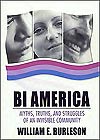
On page 11 of the book I recently  reviewed, "Bi America," there is a list of thirteen myths about bisexuality, compiled by bisexuals at a Bisexual Empowerment Conference: A Uniting Supportive Experience (BECAUSE).  Here is the list:

1. Bisexuals are easy; they are indiscriminate about whom they have sex with.

2. All bisexuals are swingers.

3. Bisexuals have the best of both worlds and are twice as likely to get a date.

4. Bisexuals are unable to commit to either gender.

5. Bisexual women are all wives just trying to please their husbands, and bisexual men are all  married  guys cheating on their wives.

6. Bisexuality is just a phase on the way to being lesbian or gay

7. Bisexuals are unable to be happy, have low self-esteem, or are mentally ill.

8. Bisexuals are disease carriers.

9.  Bisexuals are a very small part of the population.

10.  Bisexuals are just trying to maintain heterosexual privilege.

11.  Bisexuals can't be feminist.

12.  People call themselves bisexual to be trendy.

13.  Bisexuality is a choice.

Belief in myth #6 is one thing that led me so quickly to adopt the gay label without fully considering the bisexual label previously, along with feeling resonance with stories of others who now identify as gay.

Have you or do you believe any of these 13 points about bisexuals?

Sunday, January 30, 2011

Book Review: "Bi America: Myths, Truths, and Struggles of an Invisible Community"

By Mister Curie

"Bi America" was  written by William E. Burleson and published in 2005.  William Burleson is bisexual and had been publicly involved in bisexual politics for nearly 15 years when his book was published.  The book is filled with quotes from bisexuals which come from the Bi History Project in Minnesota, personal interviews conducted by Mr. Burleson, and a bisexual online support group.  Mr. Burleson also collected data from an online survey of bisexuals.

Mr. Burleson heavily relies on the stories of others to document bisexuals living in America.  In the introduction he states, "What is important are the stories of living people, living their lives.  That is what I set out to do with this project: tell our story. . . I believe what really matters are the people and their stories . . . Bi people, as is true of many other groups, are often reduced to stereotypes.  I hope to reduce bisexuality to its humanity."

I felt the overriding theme throughout this book revolves around the word "community."  What is a community?  What is the bisexual community?  What does it look like?  Where can it be found?  Mr. Burleson explores bisexual communities across America and reports on the stories of the individuals composing those communities, creating a landscape of bisexuals in America.  He concludes with an exploration of how the internet has shaped the bisexual community and what the future holds for the bisexual community.

Many times throughout the book, I found myself reflecting on the MoHo community and asking myself the same questions of the MoHo community that Mr. Burleson was trying to answer about American bisexual communities.  Mr. Burleson defines a community as a "functional group brought together by commonalities and sharing a culture of some kind to some degree."  For there to be a community, people must feel a part of that community, and the community is known to outsiders through its institutions.  It seems to me that the MoHo community is largely held together by the MoHo directory, which is a primary source for visibility to those outside the community and is a very visible reminder of those who belong to the MoHo community. Another defining institution of the MoHo community is the monthly meet-ups hosted by Scott and Sarah, which have expanded to other regular MoHo meet-ups that I am aware of in the Northwest and Northeast.   I believe one of the intentions of the MoHo Map is to help to organize such meet-ups in resonable geographic areas. The MoHo facebook group provides an online gathering place.

I think one reason the book caused me to reflect so much on the MoHo community was due to its use of stories to illustrate the rich diversity of  American bisexual  communities.  I have similarly  come to know the  MoHo community through its stories, shared on its blogs.  The MoHo community has been, and continues to be, an open and inviting place where I can share my story and compare it to the stories of others as I seek to understand who I am.  It was within the MoHo community that I finally found stories of others that paralleled mine, stories that resonated with my experiences and stories that provide me with insight and  guidance as I forge a path forward.  These were stories that let me know I was not alone in being attracted to men, that let me know my interpretations and responses to those feelings were normal within the Mormon worldview I held, that let me know that other men who are attracted to men also get married to women for a variety of reasons and sometimes before they come out to themselves about their attractions to men.

So I think it is only natural that in my sincere attempts to contemplate the bisexual orientation I would  find a  collection of bisexual stories against which to compare my story and experiences to see if it resonates with me.  References to this book will be frequent in future blog posts, time permitting, that contemplate bisexuality.

Sunday, January 23, 2011

My Mormon.org profile, again

By Mister Curie

So I haven't been able to figure out how to link to my facebook account, so I disabled that functionality with my mormon.org profile and have been waiting to see if anything would happen.

I finally got a response on my homosexuality question that "the statement is to (sic) harsh for the audience it would go to. thus it is not cleared."  I am pleased that President Kimball's statements on homosexuality are no longer deemed appropriate, but I am a little disturbed by the qualifier of "for the audience it would go to."  Is this an attempt to placate me so that I don't think they are questioning my answer, or is this an attempt to give good PR to church, giving me a wink that they agree with me but we don't want to come across as harsh to investigators?  If the later, isn't this just the continuation of dishonesty and double-speak that has plagued the church since its beginning?


So I have edited my answer on the question of homosexuality down to: "The Mormon church is firm in the conviction that homosexual behavior is offensive to God and actively works to support legislation against same-sex marriage."

I guess we'll see if that gets accepted.  My answer on the Holy Ghost is still "Pending Review."

Saturday, January 22, 2011

Science meets Lady Gaga

By Mister Curie

I had one of the busiest weeks of my PhD this past couple of weeks (and it will likely continue for the next couple of weeks) as I am trying to get things wrapped up so I can begin writing my PhD dissertation for graduation this spring.  This Lady Gaga parody hit a chord, although my project is largely going quite well.  Enjoy!

Sunday, January 9, 2011

More MOM Research

By Mister Curie

Mormons for Marriage had an interesting post that I saw this morning on mixed-orientation marriages.  Apparently the Journal of Marital and Family Therapy has recently published a review of the research that has been performed on mixed-orientation marriages over the past 20 years.  The post is an interesting read and the actual article even more so.

From the article's discussion, which I thought was a pretty apt description:

Mixed-orientation marriages are fraught with complexity, as reported in quantitative, qualitative, and case study research. Gay, bisexual, and lesbian spouses must manage homoerotic feelings or activities while maintaining their marriage and considering the needs of their straight spouse. Pressure from within is described in these data as arising from tension between societal expectations, love for spouse, and same-sex attraction; fear of losing one’s family; developing a  cogent sense of self while compartmentalizing feelings and behaviors; dealing with ambiguity about one’s sexual identity across contexts; and being able to live intentionally and with integrity. Renegotiation of sexuality within marriage is a challenge for both partners in MOM, as is finding a network that accepts and supports both the individuals and couple as a whole. Friendship and love between spouses, along with shared children, led to family life and community integration. These were reported to deter couples from separating and to enhance their general life satisfaction.

And regarding the wives in a MOM:

Straight women in MOM experienced an array of responses after their husband’s coming out, ranging from outrage to relief. Such women’s experiences were often conceptualized in terms of loss, shock, and sadness. Responses included isolating themselves, feeling humiliated, seeking counseling, and attempting to renegotiate or dissolve their marriage. Many women sought counseling to reorganize their feelings and thoughts about their marriages. Sexual practices in marriages that endured included monogamy, celibacy, menage a` trois, open marriage, and variations on an agreement not to discuss extramarital sexual activity.

Thursday, January 6, 2011

Research on Committment within Mixed-Orientation Marriages

By Mister Curie

I received an interesting comment on a post the other day from a former Mormon graduate student doing a study on commitment in Mixed-Orientation Marriages.  He is looking for couples to interview about their Mixed-Orientation marriages.  Unfortunately I do not currently qualify for the study because I have not been out to my wife for two years yet.  However, if any of my readers qualify for the study and are interested, I would encourage you to contact him and to participate in the study.  I think the results of the study could be very interesting and useful to others in MOMs, therapists working with people in MOMs, etc.

Here is copy of the comment for those interested:

I am a graduate student of family studies at Iowa State University. I am doing my dissertation research on commitment in mixed-orientation relationships (gay or bisexual man partnered with a woman). Earlier research has reported that there are approximately two million mixed-orientation marriages in the U.S. and that 15% of these marriages continue past 3 years. 

Participants qualify IF:

• The male identifies as anything but heterosexual, including homosexual, gay, bisexual, queer, pansexual, and so on.
• The non-heterosexuality of the male has been acknowledged between the couple for at least two years.
• The couple is in a committed intimate relationship, legally recognized or not.
• Both partners are willing to be interviewed.

The female partner may be of any sexual orientation. The couple need not be in a sexually monogamous relationship, but they should identify each other as their primary partner.

I plan to interview each partner individually at least once, and the couple together at least once, by phone or Skype. Interviews will last approximately 60 minutes. Participant identity will be kept confidential.

Those interested in participating in the study can contact me by email at kevinz@iastate.edu or by phone at 515-441-9397.

I've seen your blog before and hope you'll be willing to participate, and to pass the announcement along to anyone who may be interested. My wife and I also married as Mormons, although I'm atheist now as well. 

Thank you for your time!

Kevin Zimmerman
Graduate Student
Department of Human Development & Family Studies
Iowa State University

Wednesday, January 5, 2011

Contemplating Bisexuality

By Mister Curie

With it being roughly a year since I began to blog, I have been reviewing some of my early posts and the progress I have made exploring my thoughts and feelings on this blog.  In my first post coming out, I wrote, "I am questioning now, but I think that I am bisexual".  I then wrote a post about bisexuality, noting a study that brought into question the existence of bisexuality as well as the common notion that bisexuality is a transition period as one accepts their homosexuality.  Then I wrote a long series of posts where I explored the past and acknowledged my attraction to men throughout my life.  In the final post of that series, I ranked myself on the Klein grid, determining I was probably about a 5 on the Kinsey scale and wrote, " I definitely can't claim to be equally attracted to men and women, even with the abundance of attraction I feel for my wife, so I don't think bisexual is the correct label for me. I guess I'll embrace the homosexual label."

I then went through a challenging and enriching period of time, struggling to understand what being gay meant and striving to overcome my own internalized homophobia.  Over the summer I came out as gay to my parents and siblings.

And now I am back to contemplating bisexuality.  I have been reading some books on bisexuality, including "Bi America" and "Dual Attraction".  I think my initial dismissal of bisexuality may have been too quick and uninformed.  So, time permitting, I intend to explore some of my thoughts from reading these books and where I identify with these books.  Some of the struggles are different, but many of the struggles of the bisexual person are similar to the struggles of a homosexual person.  Both are attracted to persons of the same gender and both need to decide what to do about those attractions.  As I wrote in my first post, "I think being in the church is probably easier for the bisexual than for the homosexual. . . . Bisexuality [allowed] me to focus on my heterosexual feelings within my LDS belief system and ignore my homosexual feelings. . . . I had heterosexual feelings I could explore. Any homosexual feelings that I chose not to pursue were easily ignored due to my LDS church belief system, as well as the cultural mindset I was raised with."

As I have learned since becoming disaffected from the church, the world is not composed solely of black and white, good and evil, gay or straight in easily and rigidly defined dichotomies, rather there is a rainbow of variation that is good and wonderful in the world.  It was easy to quickly dismiss bisexuality when I was first acknowledging my attractions to men because I was still used to operating in a black/white world view (in fact I still have some difficulties escaping the black/white world view at times, much to my wife's dismay).  So this is going to be a concentrated effort at avoiding black/white dichotomies and instead explore the richness and depth that comes from contemplating the vast middle ground.